

Independent-fit comparison
5 Ecommerce Chatbot Tools Compared for Small Shopify Stores
A public-source comparison of DocMind, Gorgias, Intercom Fin, Zendesk, and Tidio—built around the jobs, cost units, and limits that matter to a small online store.
- Author
- By Di - Founder of DocMindSolo founder building DocMind from Melbourne, Australia
- Published
- Updated
- Reviewed sources
- Official Shopify, DocMind, Gorgias, Intercom, Zendesk, and Tidio product and pricing pages.
TL;DR
No ecommerce chatbot wins every use case. DocMind fits approved-content support for small stores; Gorgias fits deeper Shopify operations; Intercom Fin and Zendesk fit existing service platforms; Tidio combines live chat with an accessible AI entry point. Compare complete cost, safe answer scope, and handoff—not a feature count.
It is Sunday evening and one person is covering the store. A shopper asks whether a product fits, another wants a parcel update, and a third wants an exception to the return policy. All three messages look like “chat,” but they require different data, authority, and escalation. Buying one impressive demo does not solve that operating problem.
This guide separates those jobs before comparing tools. I founded DocMind, so that is a material conflict to disclose. The comparison uses publicly available vendor documentation and live pricing pages reviewed on 5 August 2026; it is not a claim that I ran account-level tests inside every competing product.
How did we evaluate ecommerce chatbot tools?
We used six disclosed criteria: approved-content control, Shopify workflow depth, human handoff, setup path, pricing model, and the main limitation. Each criterion answers a buying question a small store can verify. Vendor claims come from official pages; fit judgments are our analysis, not hands-on performance benchmarks.
| Criterion | What we checked |
|---|---|
| Approved-content control | Can the store select, refresh, and constrain the sources used in customer answers? |
| Shopify workflow depth | Does the tool only answer policy questions, or can it use current order and storefront context? |
| Human handoff | Can the system stop cleanly and pass the conversation to a person with useful context? |
| Setup path | Can a small team launch from existing content, or does the product assume a larger helpdesk project? |
| Pricing model | Is cost driven by plans, seats, tickets, conversations, outcomes, or a mixture of those units? |
| Main limitation | What important job, cost risk, or operating requirement makes the tool a poor fit for some stores? |
“Easy setup” means the documented path appears workable for a small team; it is not a timed result. “Weakness” means a boundary visible in packaging, workflow, or pricing—not a claim that the product fails. Shopify’s current AI chatbot overview is useful category context, but stores still need to verify each vendor’s current terms.
This shortlist is intentionally centred on Shopify. Stores running WordPress should use the separate WooCommerce chatbot setup guide, which covers plugin, source, order-data, and deployment questions that do not belong in a Shopify buying matrix.
Which tools made the shortlist?
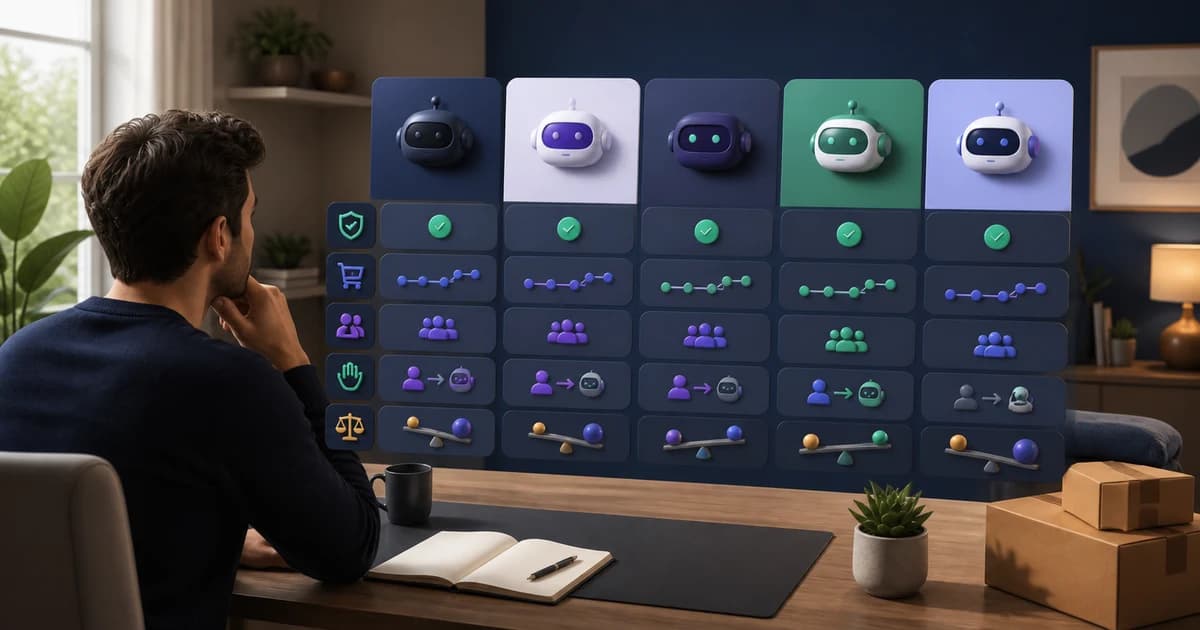
The shortlist covers five distinct buying paths: a focused approved-content assistant, a Shopify-native helpdesk, an outcome-priced AI agent, an enterprise service suite, and a live-chat-led option. The matrix keeps DocMind inside the same criteria and shows each product’s main weakness rather than assigning a universal first place.
| Tool | Best fit | Approved-content path | Shopify workflow | Human handoff | Setup path | Pricing model | Main weakness |
|---|---|---|---|---|---|---|---|
| DocMind | Small stores that want answers constrained to approved store content | Website pages, files, FAQs, and pinned Instant Answers | Order tracking on every paid plan; product and policy content across plans | Ticket handoff for exceptions | Self-serve source import with founder-guided help available | Plan and message allowances; no per-ticket or per-resolution fee | Not a full omnichannel helpdesk or deep order-action suite |
| Gorgias | Shopify teams that need a helpdesk plus ecommerce actions | Help-centre, website, document, guidance, and Shopify data sources | Deep native Shopify context and order-management workflows | AI Agent inside the Gorgias helpdesk | Connect sources, rules, channels, and ecommerce actions | Helpdesk tier plus automated-interaction allowances and overages | More operating depth and usage variables than many tiny stores need |
| Intercom Fin | Teams already using Intercom for support | Configured support content and existing Intercom workspace context | Ecommerce fit depends on the surrounding Intercom setup and integrations | Hands unresolved conversations to support teammates | Lowest switching friction for an established Intercom team | US$0.99 for a standard Fin outcome; qualification is priced separately | Outcome charges sit beside the broader platform decision |
| Zendesk | Larger teams that need structured omnichannel service operations | Knowledge-base content inside a mature service suite | Available through the wider app and workflow ecosystem | Agent workspace, routing, ticketing, and service controls | Admin-led suite configuration rather than a narrow widget launch | Per-agent plans plus automated-resolution billing for AI agents | Broader suite cost and administration can exceed a small store’s need |
| Tidio | Small stores that want live chat and an AI starting point together | Lyro learns from the support content the store provides | Shopify app and selected native actions | Transfers conversations from Lyro to a human operator | App-led live-chat and AI deployment | Separate helpdesk and Lyro allowances; first 50 Lyro conversations are free | Plan and conversation limits need checking as volume grows |
Treat the table as a routing device, not a substitute for a trial. List the ten questions your store sees most, mark which need only published content and which need authenticated order data, then use the Shopify chatbot knowledge-base checklist to prepare the source set before any vendor demo.
When does DocMind fit a small Shopify store?
DocMind fits a solo founder or small team that wants answers grounded in approved website pages, files, FAQs, and pinned responses without adopting a full helpdesk. It is less suitable when the store needs complex omnichannel queues, deep order edits, or a large service operation inside the same platform.
Where the fit is strongest
A store can import the product, shipping, return, and help content it already owns; use Instant Answers for must-get-right replies; and hand exceptions into tickets. The product is deliberately positioned for small Shopify stores and founder-led teams, not as an all-purpose company service desk.
The live DocMind pricing page lists Starter at US$9.90 per month, Personal at US$29, and Standard at US$59. Every paid plan includes Shopify order tracking, and every plan replies in 95+ languages. Plans use message allowances, and DocMind does not add a per-ticket or per-resolution charge.
Where another tool is stronger
DocMind is not the right promise for a merchant that wants one system to run every support channel, staff assignment, service level, refund, and order edit. Its strength is the governed answer layer. The broader ecommerce AI support decision page explains that narrower role before a buyer enters a product trial.
When is Gorgias worth the extra depth?
Gorgias is the stronger fit when Shopify support operations need native order context, ecommerce actions, multiple channels, and an AI agent inside the same helpdesk. That depth has more setup and pricing variables, so a tiny store should confirm that the workflows it will actually use justify the wider platform.
Gorgias documents AI Agent sources including Shopify data, a store website, help-centre articles, URLs, documents, and custom guidance. It also describes ecommerce actions and a handoff into the helpdesk. That makes the product a credible choice when customer support must do more than explain published policy.
On the live Gorgias pricing page, the monthly Starter plan is US$40 for 50 tickets and 30 automated interactions. The table shows tier-specific allocations and overages, including a US$1.50 automated-interaction overage on Starter. Verify the current tier because packaging and rates can differ across plans.
The practical decision is whether you need those order and helpdesk actions now. If most questions are product facts, shipping rules, and return guidance, start narrower. If agents routinely edit orders, coordinate channels, and manage exceptions, the deeper platform may reduce tool-switching enough to justify its operating cost.
Who should choose Intercom Fin or Zendesk?
Choose Intercom Fin when support already lives in Intercom and outcome pricing matches the expected volume. Choose Zendesk when the business needs a mature agent workspace, ticketing, routing, knowledge, and omnichannel administration. Neither is automatically wrong for a small store, but both are broader platform decisions than adding a focused website assistant.
Intercom Fin: minimise switching when Intercom is already home
Intercom defines a standard Fin outcome as a resolution, a procedure handoff, or a disqualification. Its current Fin outcome documentation lists US$0.99 for that outcome and US$9.99 for a qualification, with one charge per conversation. Model peak-season outcomes rather than multiplying a marketing resolution rate by average traffic.
Zendesk: buy it for service operations, not only the bot
Zendesk’s live pricing page lists Support Team at US$19 per agent per month and Suite Team at US$55 when billed annually. AI agents are available across plans, while successful automated resolutions are a separate billing unit. The public page does not show one universal per-resolution price, so request the applicable quote.
A small merchant should compare the whole system cost: agent seats, AI outcomes or resolutions, channels, implementation, and the people needed to maintain it. The chatbot ROI calculator helps model those units without assuming that every contained conversation is a clean, permanent saving.
Is Tidio the simplest live-chat starting point?
Tidio is a practical starting point when a small store wants human live chat and an AI agent in one app-led experience. Lyro learns from provided support content and can transfer to an operator. The tradeoff is that helpdesk and AI conversation allowances must be checked separately as usage grows.
Tidio’s live pricing page lists the Starter helpdesk at US$24.17 per month on annual billing and Lyro AI Agent from US$32.50 per month for 50 conversations. It also offers the first 50 Lyro conversations free for the lifetime of an account.
That packaging is approachable for a merchant that still expects people to answer live. Before choosing it, test what happens after the included allowance, which Shopify actions exist on the intended plan, and how the handoff works outside business hours. A cheap starting tier is useful only if the growth path stays understandable.
How should a small store run a 14-day evaluation?
Run the evaluation against real store content and a fixed question set, not a polished vendor script. Test correct answers, deliberate unknowns, authenticated-data boundaries, handoff, maintenance, and peak cost. Fourteen days is a practical review window, not a claim that every vendor offers the same trial length.
Days 1–2: define the jobs and boundaries
Export 30 recurring questions. Label each as approved-content, live-order, staff action, or human judgment. A bot should never quietly treat those categories as interchangeable.
Days 3–5: prepare the source pack
Use current product pages, shipping rules, returns, warranty, promotions, and escalation text. Remove conflicts and drafts before ingestion; the model cannot repair contradictory policy safely.
Days 6–9: test both answers and refusals
Ask common questions, ambiguous variants, expired-policy questions, unsupported products, and requests for exceptions. Record accuracy, source alignment, refusal quality, and whether handoff includes the prior context.
Days 10–12: model normal and peak cost
Calculate seats, tickets, messages, conversations, automated outcomes, and overages using the vendor’s actual billing unit. Include reopened cases and human cleanup rather than counting every automation as a saving.
Days 13–14: choose one controlled launch
Launch the narrowest high-volume workflow, publish the human contact path, and assign an owner for source updates and transcript review. Expand only after the first workflow stays accurate.
Which ecommerce chatbot tool should you choose?
Choose the narrowest tool that safely covers the jobs you can document today, then expand only when a real workflow requires it. The recommendation follows the disclosed criteria: DocMind for controlled small-store answers, Gorgias for deeper Shopify operations, Intercom or Zendesk for existing suites, and Tidio for live-chat-led teams.
| Your situation | Start with | Verify before buying |
|---|---|---|
| Solo founder; approved FAQs and policies are the main support surface | DocMind | Source coverage, message allowance, and whether live order tracking is needed |
| Shopify helpdesk team needs order actions and channel management | Gorgias | Ticket tier, automated-interaction allowance, overages, and required actions |
| Support already runs in Intercom | Intercom Fin | Which events count as outcomes and likely peak volume |
| A larger service team needs mature ticketing and administration | Zendesk | Agent plan, automated-resolution quote, integrations, and admin effort |
| Small store wants live chat and AI in one approachable entry point | Tidio | Lyro allowance, helpdesk tier, Shopify actions, and after-hours handoff |
If DocMind matches the first row, review the current plans and Shopify feature boundaries before trying it. The free path lets a store inspect the product without a card, but the same evaluation questions should still be applied.
Watch an approved-content ecommerce chat
This existing walkthrough shows how DocMind handles product and policy questions from an approved knowledge source. It demonstrates the customer-facing answer experience; it does not prove competitor performance, order-action coverage, or a particular setup duration. Use it as one product-specific input beside the neutral evaluation checklist above.
Test one real support workflow
Upload the approved pages behind your most repetitive questions, test what the assistant answers and refuses, and keep exceptions ready for a person.
Start a free DocMind workspaceFrequently asked questions
These answers cover the buying questions that pricing grids often hide: how to compare unlike billing units, where live order data changes the risk, whether a focused chatbot replaces a helpdesk, and how to govern unsupported questions. Recheck vendor terms whenever packaging or store volume changes.
What is the best ecommerce chatbot for a small Shopify store?
There is no universal winner. DocMind fits stores that prioritise approved-content answers and predictable plans; Gorgias fits deeper Shopify operations; Tidio combines live chat with an AI entry point. Intercom Fin and Zendesk make more sense when the store already runs those broader support platforms.
How much do ecommerce chatbot tools cost?
Pricing uses different units, so headline prices are not directly comparable. Vendors may charge by plan, seat, ticket, conversation, or automated outcome. Model your normal and peak volume, include the helpdesk base cost, and confirm the current allowance and overage terms on each vendor’s official pricing page.
Should a chatbot answer order-status questions?
Only when it can use authenticated, current order data. A knowledge-base answer can explain the tracking process, but it cannot know a shopper’s live parcel state. Test identity checks, delayed scans, split shipments, missing parcels, and the human handoff before allowing order-specific responses.
Can an ecommerce chatbot replace a helpdesk?
Usually not for every store. A focused chatbot can handle approved product, shipping, return, and policy questions before they become tickets. A helpdesk remains useful for email, social channels, assignments, service levels, refunds, disputes, and cases that require account access, evidence, or staff judgment.
How should a store prevent chatbot hallucinations?
Limit the bot to reviewed store sources, pin must-get-right policy answers, define when it must say it cannot verify something, and route exceptions to a person. Test unsupported questions as deliberately as common ones, then review live conversations whenever products, promotions, shipping windows, or policies change.
Reviewed sources
Reviewed on 5 August 2026 against official product, help, and live pricing pages. Prices below are public list prices in each vendor’s displayed currency and may exclude tax, annual-billing differences, implementation, or negotiated terms. Product fit is an inference from those sources, not a substitute for account-level testing.
- Shopify — AI chatbots for ecommerce (updated 22 July 2026).
- DocMind — current plan pricing and feature boundaries.
- Gorgias — current helpdesk and AI Agent pricing.
- Gorgias — AI Agent pricing model, sources, actions, and handoff.
- Intercom — Fin AI Agent outcomes and billing definitions.
- Zendesk — current Support, Suite, and AI agent pricing structure.
- Tidio — current helpdesk and Lyro AI Agent pricing.